Verizon Design Innovation
Building the strategic framework that matured a design organization from siloed execution to end-to-end, customer-centric thinking.
Client
Verizon
Mar 2024 - Jan 2025
Contribution
Lead Experience Architect
Service Design Strategist
Team
Design Manager
2 Junior Designers
Partners
Product Managers & Owners
Consumer Marketing Research
Legacy CX Teams
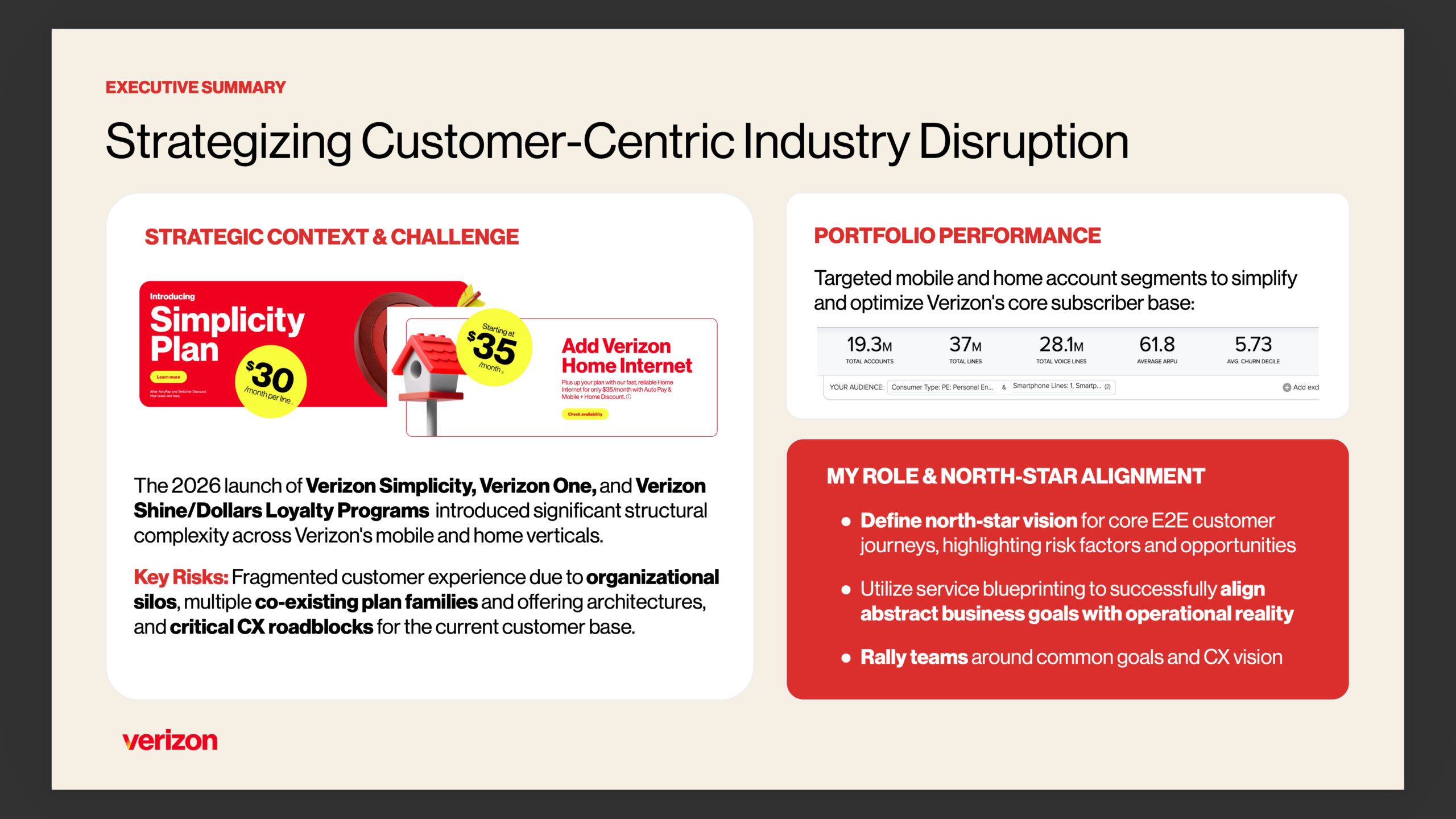
Everyone at Verizon wanted to be customer-centric, but nobody agreed on what that meant.
Legacy teams each defended their own framework for understanding the customer, so research was repeated and journeys broke at every handoff. I led the execution of the Customer Intents Framework that united every design team under one language, and cut research-to-roadmap time for downstream teams by 40%.
Impact
at-a-glance
15
teams adopted the strategic customer-centric framework
75+
practitioners in the service blueprinting community of practice I built
40%
faster research-to-roadmap for downstream teams using my blueprints
TL;DR Summary
Problem: Verizon's legacy teams each ran their own customer framework, so research and process mapping were duplicated, and leadership priorities kept shifting.
What I did: Led the Get a New Phone pilot, delivered 6 core service blueprints, built a service blueprinting community of practice, and trained teams to blueprint on their own.
Outcome: One framework and one customer language across every design team. A product operating model built around the customer intents framework. 40% faster research-to-roadmap downstream.
My role: I owned execution of the strategy end-to-end, leading two junior designers under a design manager.
The problem: too many versions of the customer
Verizon didn't lack customer insight. It had decades of it, spread across legacy teams that each mapped the customer their own way.
That fragmentation had a cost:
- Research was repeated. Downstream teams re-ran research and process mapping that already existed somewhere else.
- Journeys broke at handoffs. A customer moving from store to app to care crossed team boundaries that weren't designed to connect.
- Product had no shared priorities. Without one model of what customers were trying to do, roadmaps reflected org charts instead of customer needs.
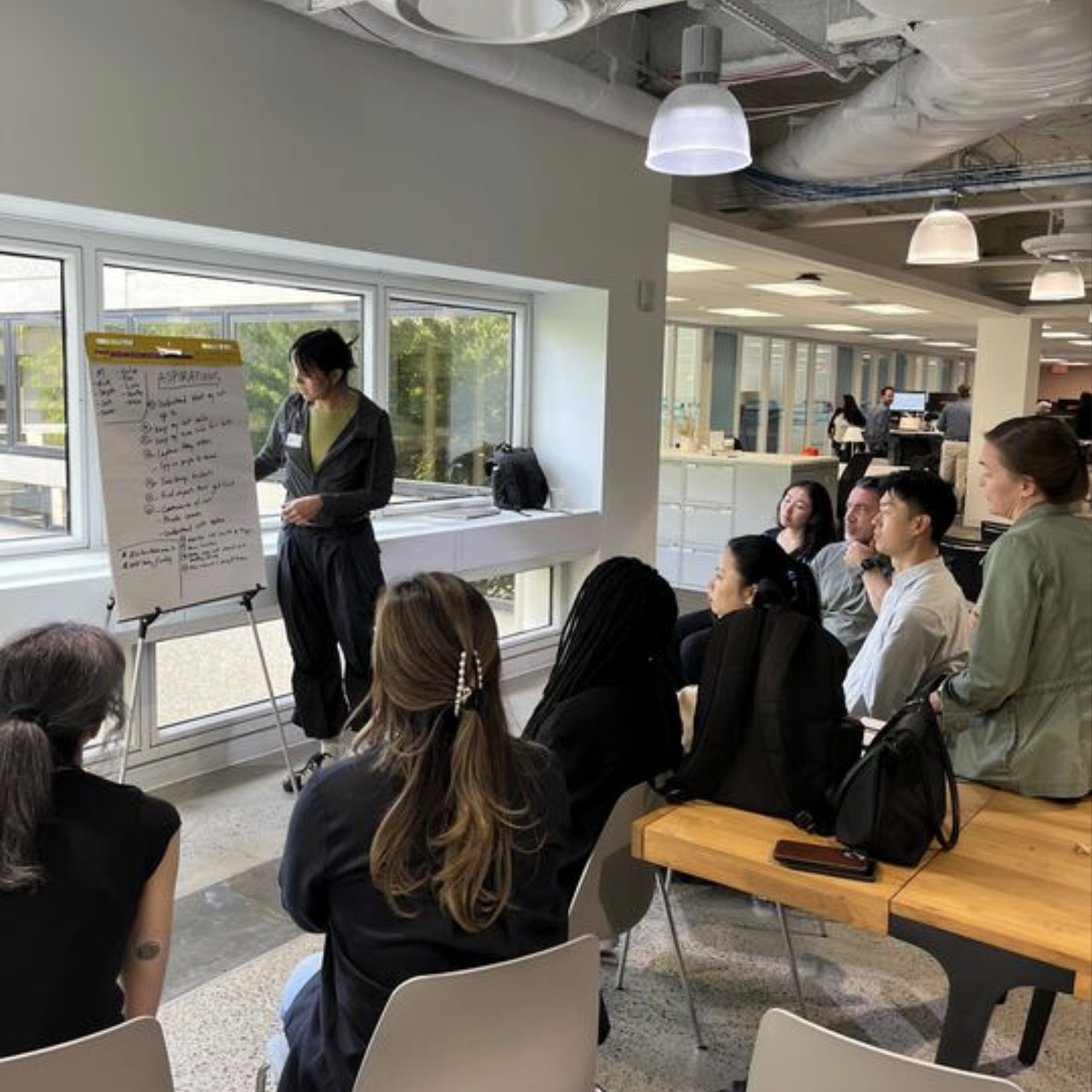
My team was new to the org. To change how legacy teams worked, we first had to earn the right to be heard.
My role
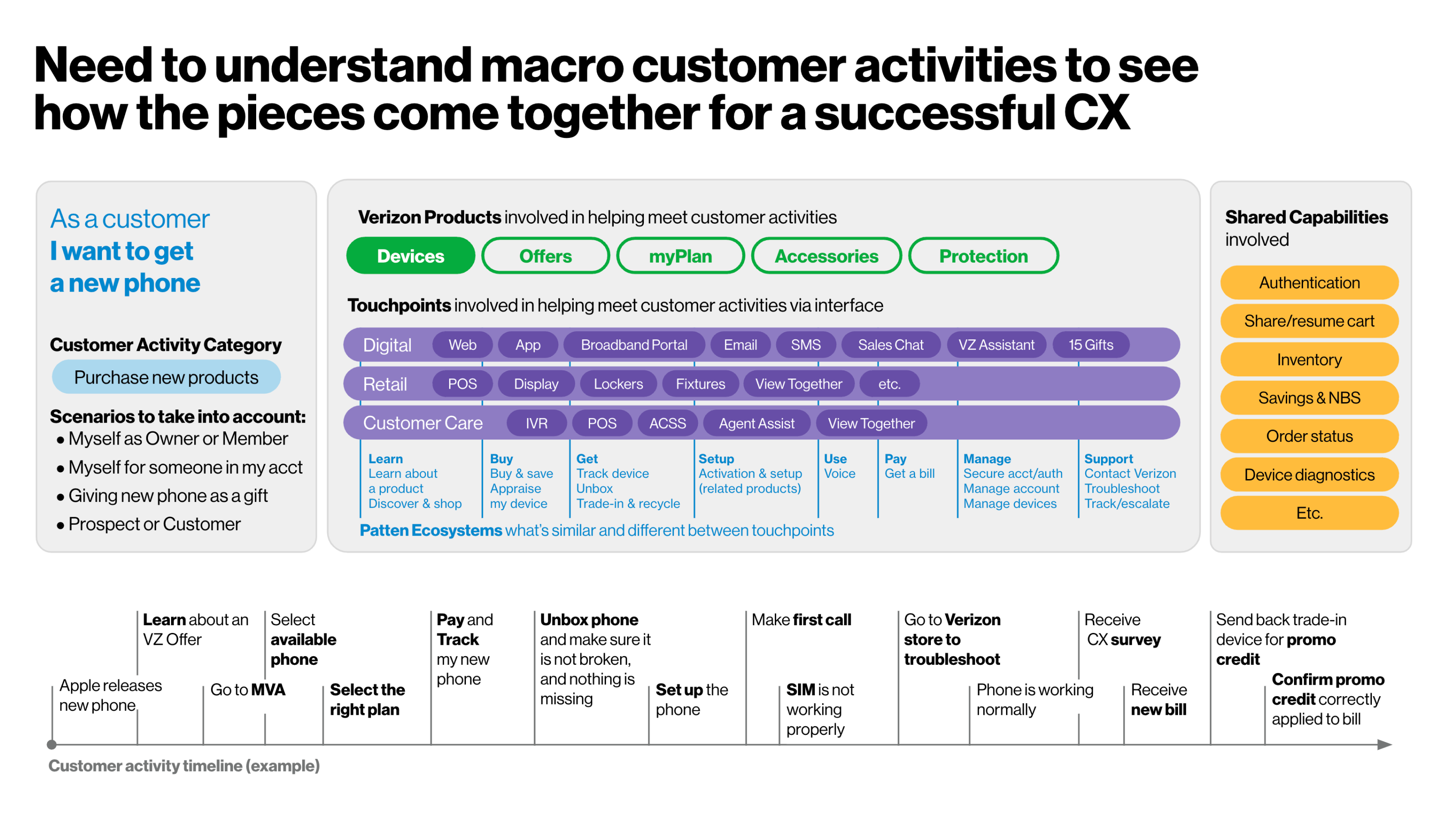
I owned execution of the strategic framework, from first pilot to org-wide practice. I led two junior designers and partnered with my design manager on strategy and executive alignment.
What I owned:
- Pilot lead for the Get a New Phone journey, including stakeholder engagement across legacy teams
- 6 core service blueprints, built and delivered
- Community of practice, which I built to scale service blueprinting beyond my team
- Training so other designers could run service blueprinting themselves
- Research studies, which I drafted
- Ad hoc consultations helping teams apply our blueprints to their own work
The insight: customers don't think in terms of lifecycle stages
Customers don't think in channels, teams, or customer lifecycles. They show up with an intent, like "I need a new phone," and expect Verizon to carry it from start to finish.
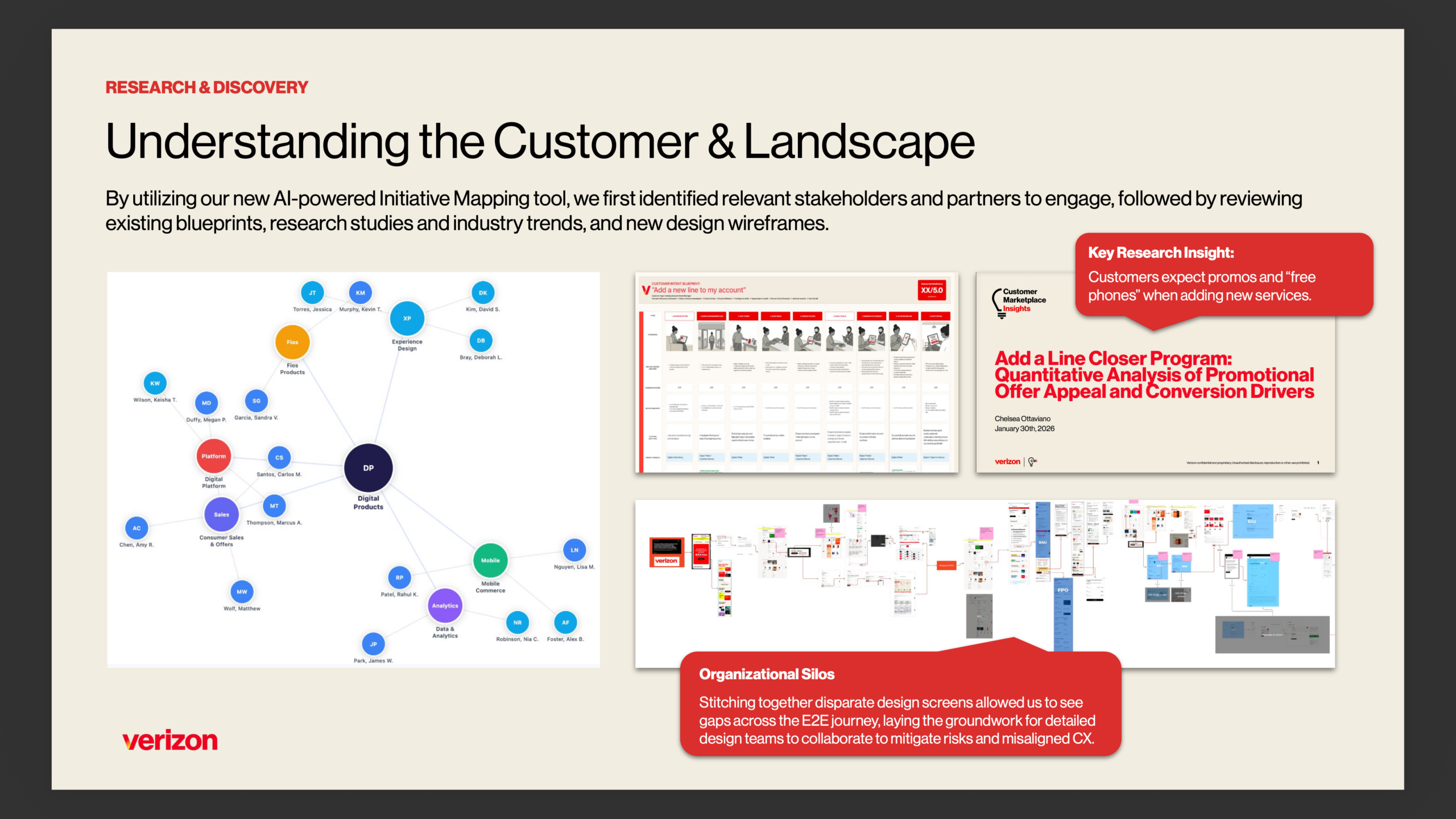
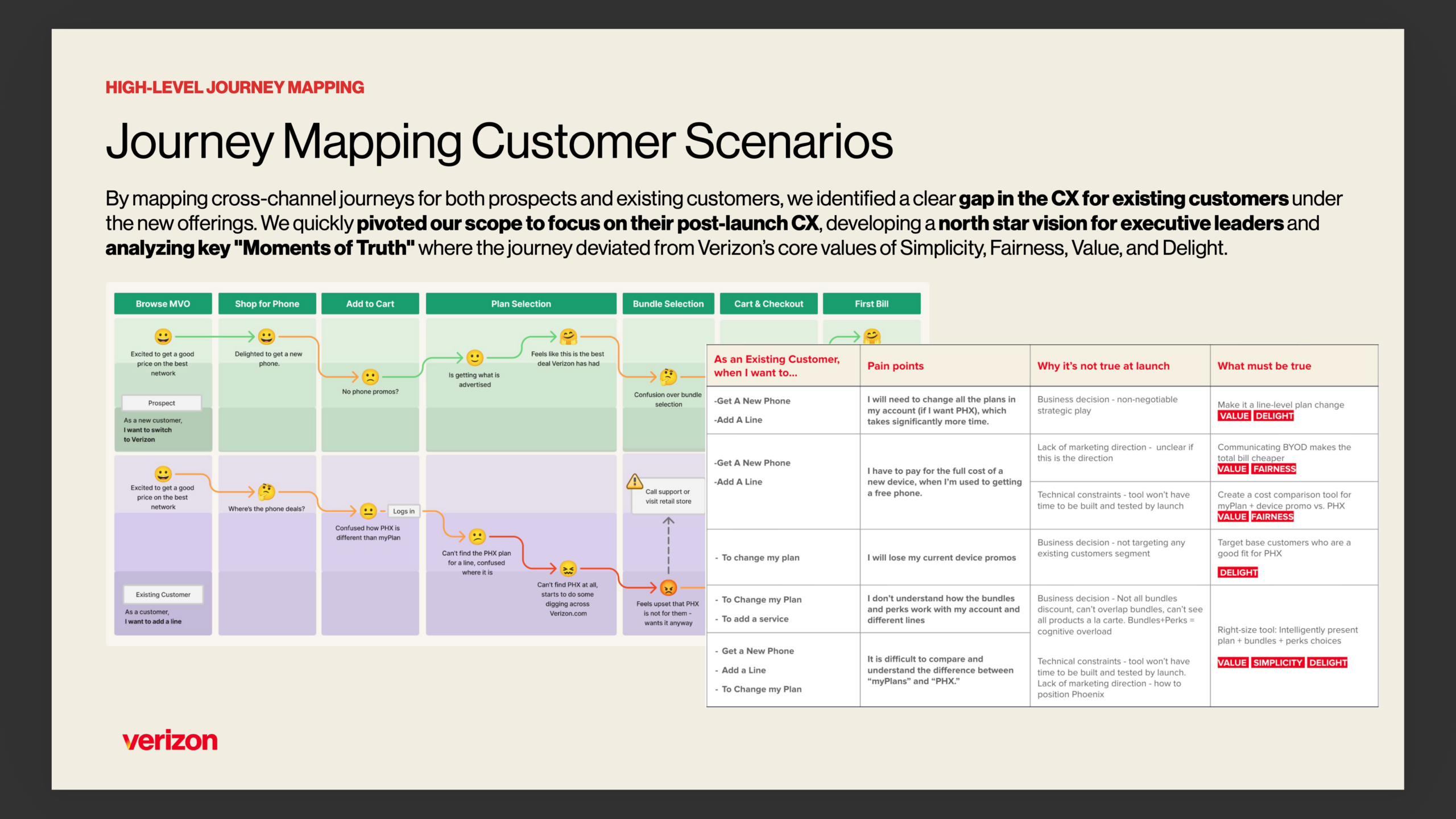
Our research on the Get a New Phone journey made this concrete: each purchasing channel—digital, retail, and call/chat—featured conflicting information and different purchasing processes for customers.
"I spent over three hours at two Verizon stores trying to buy an in-stock phone, only to be turned away by incorrect inventory and hit with a phantom order I didn't place..."
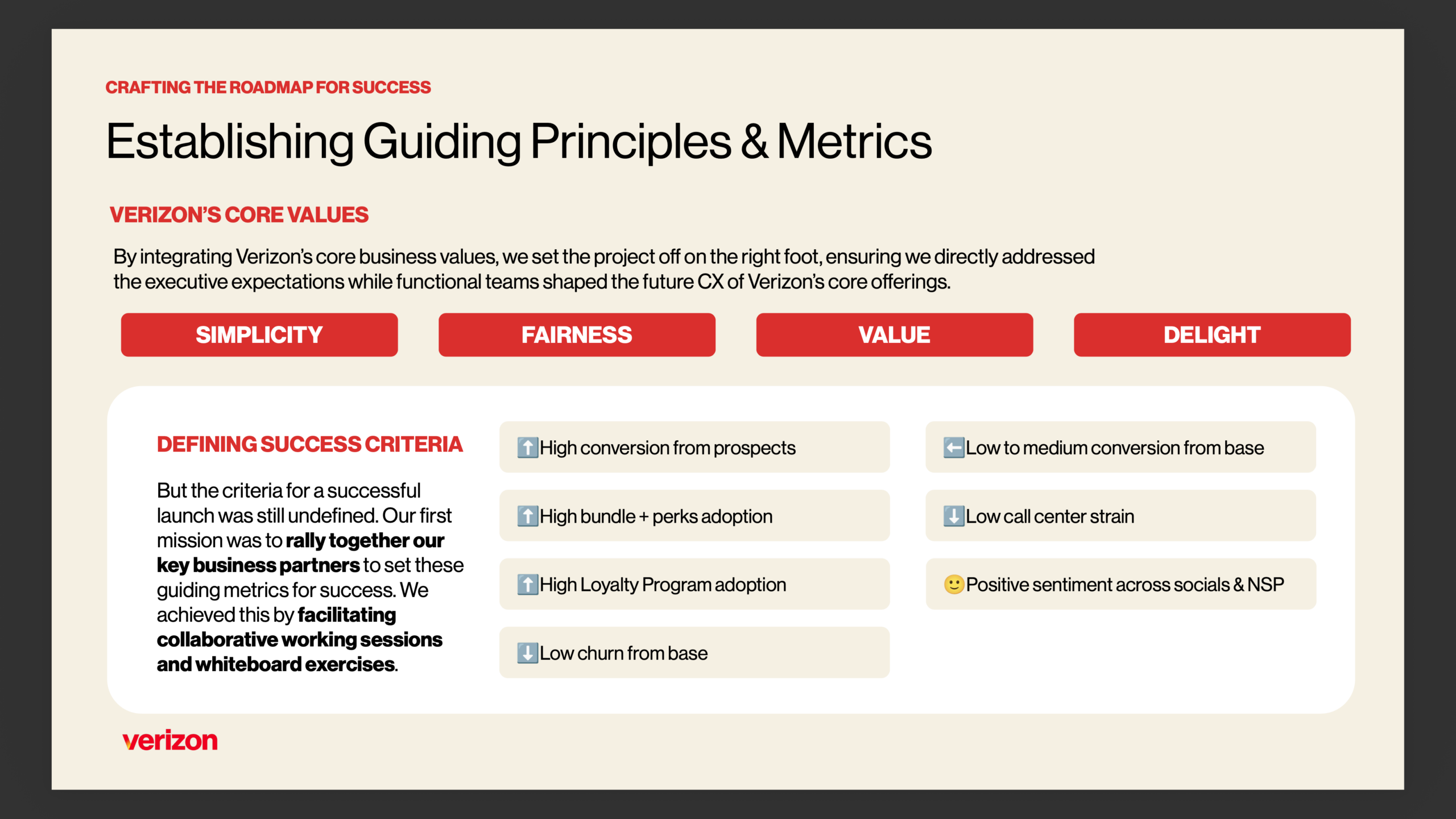
If intents were how customers saw Verizon, intents could be the one language every team shared, regardless of which framework they came from.
The framework: one customer language
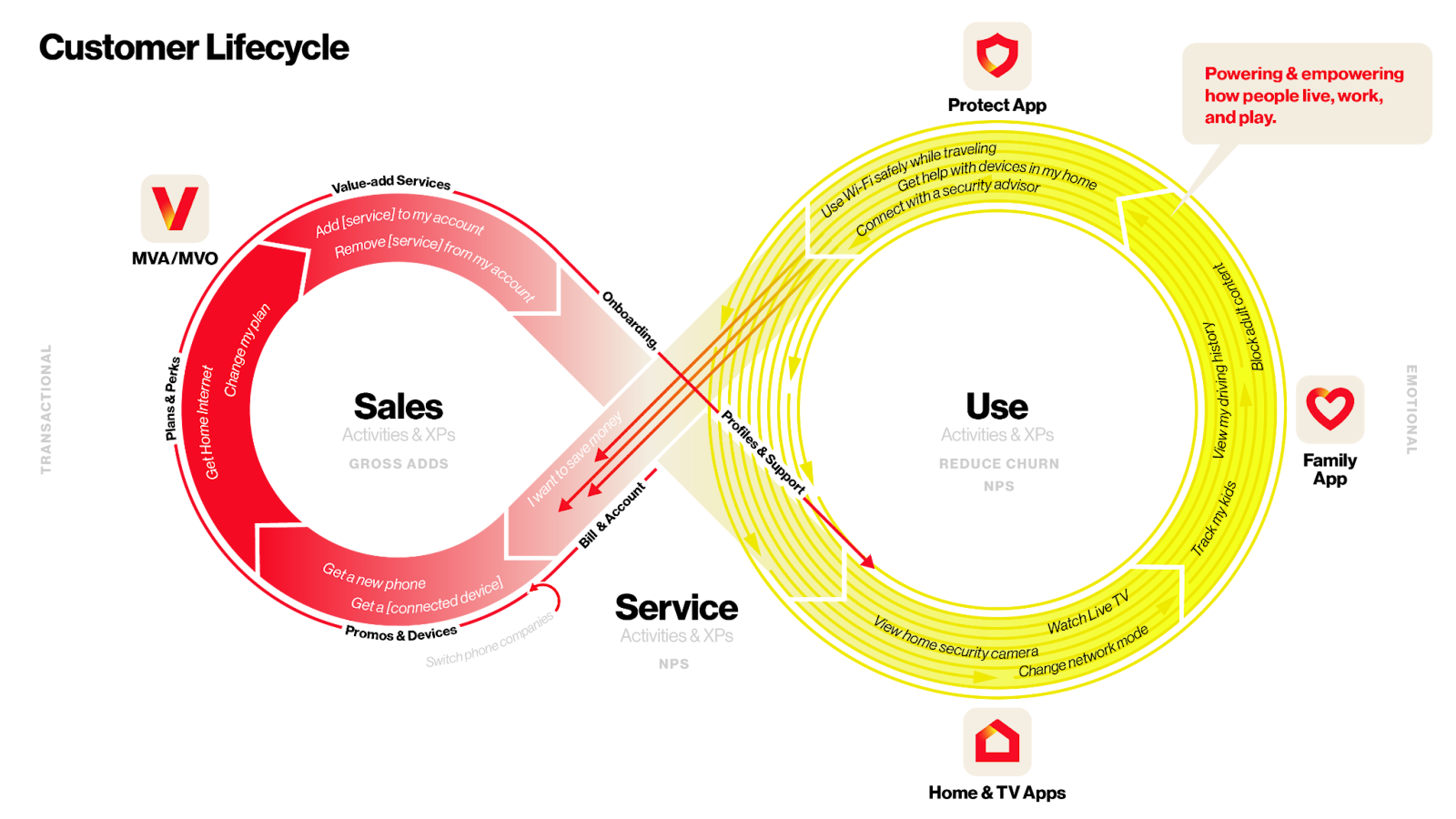
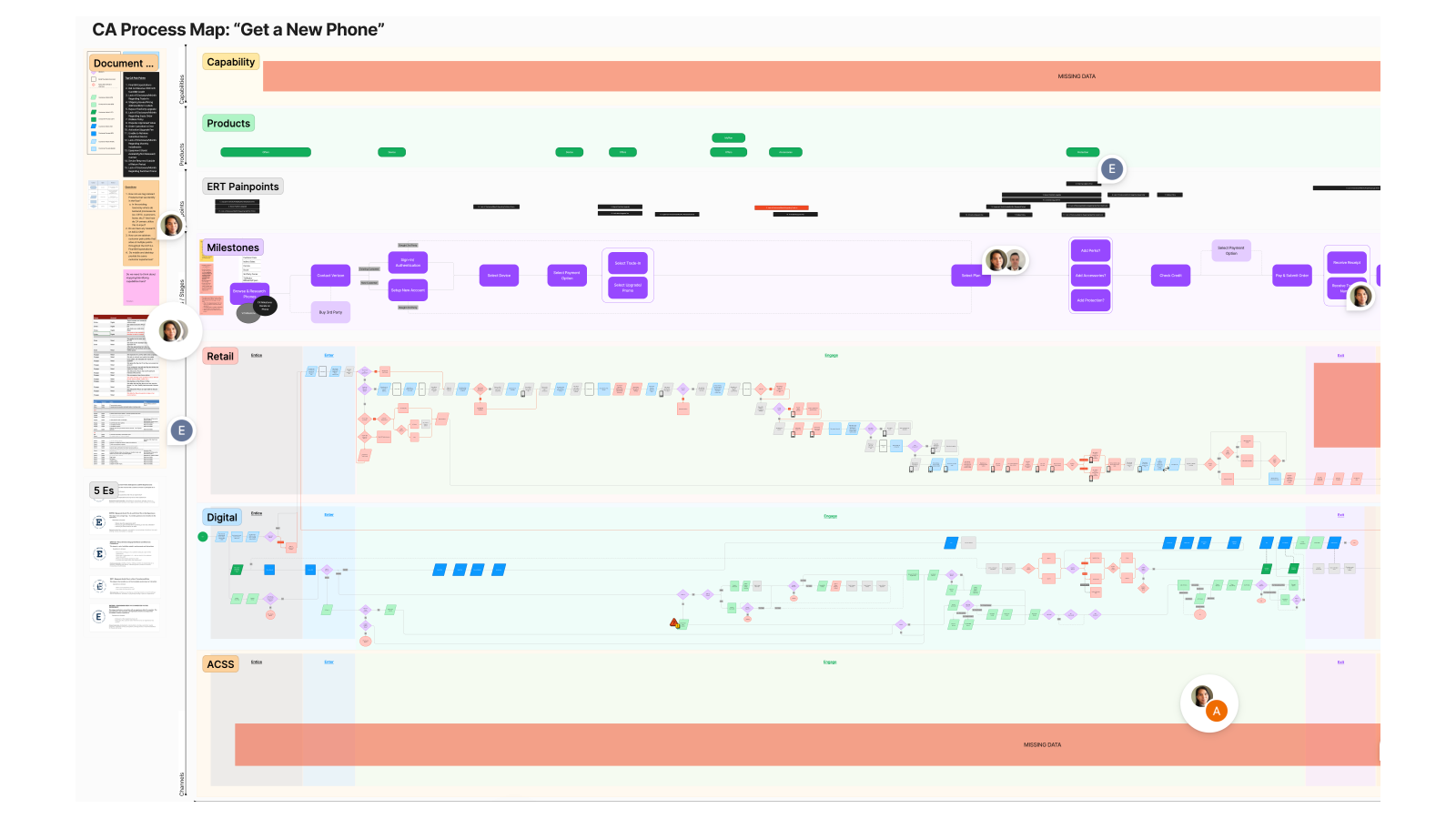
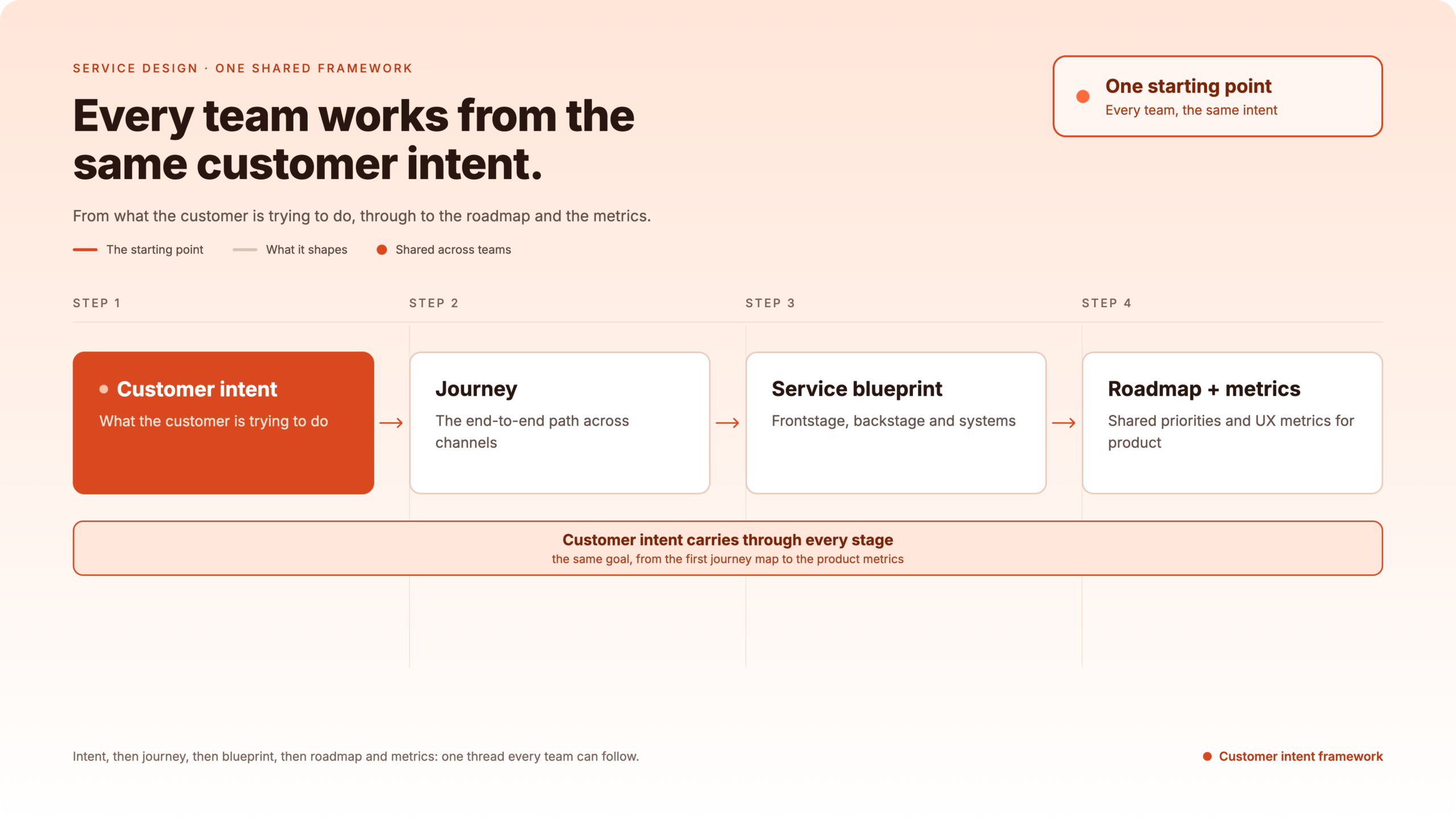
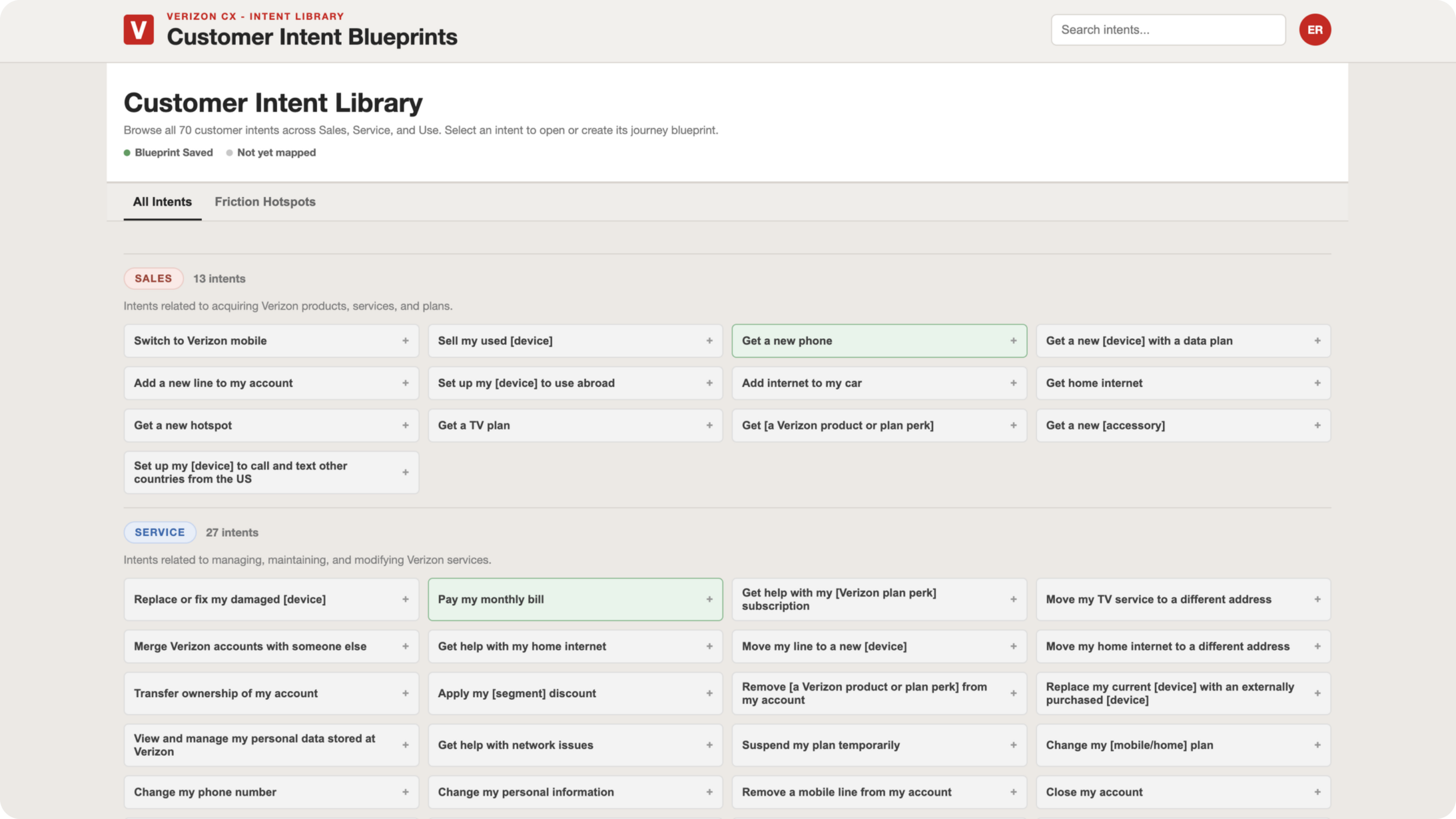
The Customer Intents Framework organizes everything around what customers are trying to do, not which team owns the touchpoint. We created an inventory of intents; each intent anchors a journey, each journey gets a service blueprint, and each blueprint feeds the roadmap and the metrics product teams are measured on.
Because every team starts from the same intent, a blueprint built once can be reused by any team downstream. That reuse is where the 40% time savings came from.
Proving it: the Get a New Phone pilot
I didn't pitch the framework in a deck. I proved it on one journey with the legacy teams who had the most reason to resist it.
Get a New Phone was the right test: it was the most common customer intent, and it spans the full lifecycle, from sales through service, so every partner team had a stake in it. That made it neutral ground to work through competing frameworks together.
What the pilot delivered:
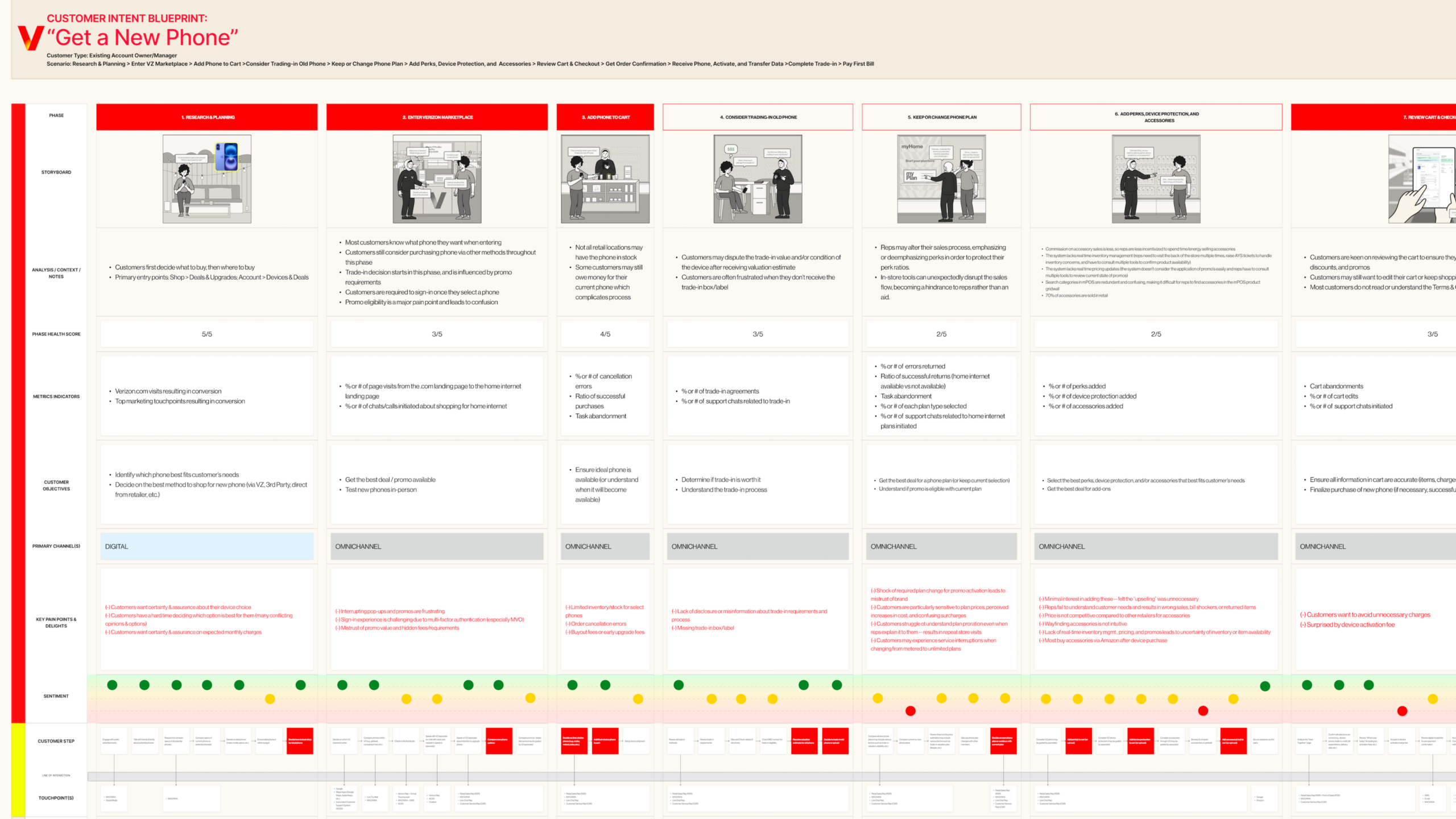
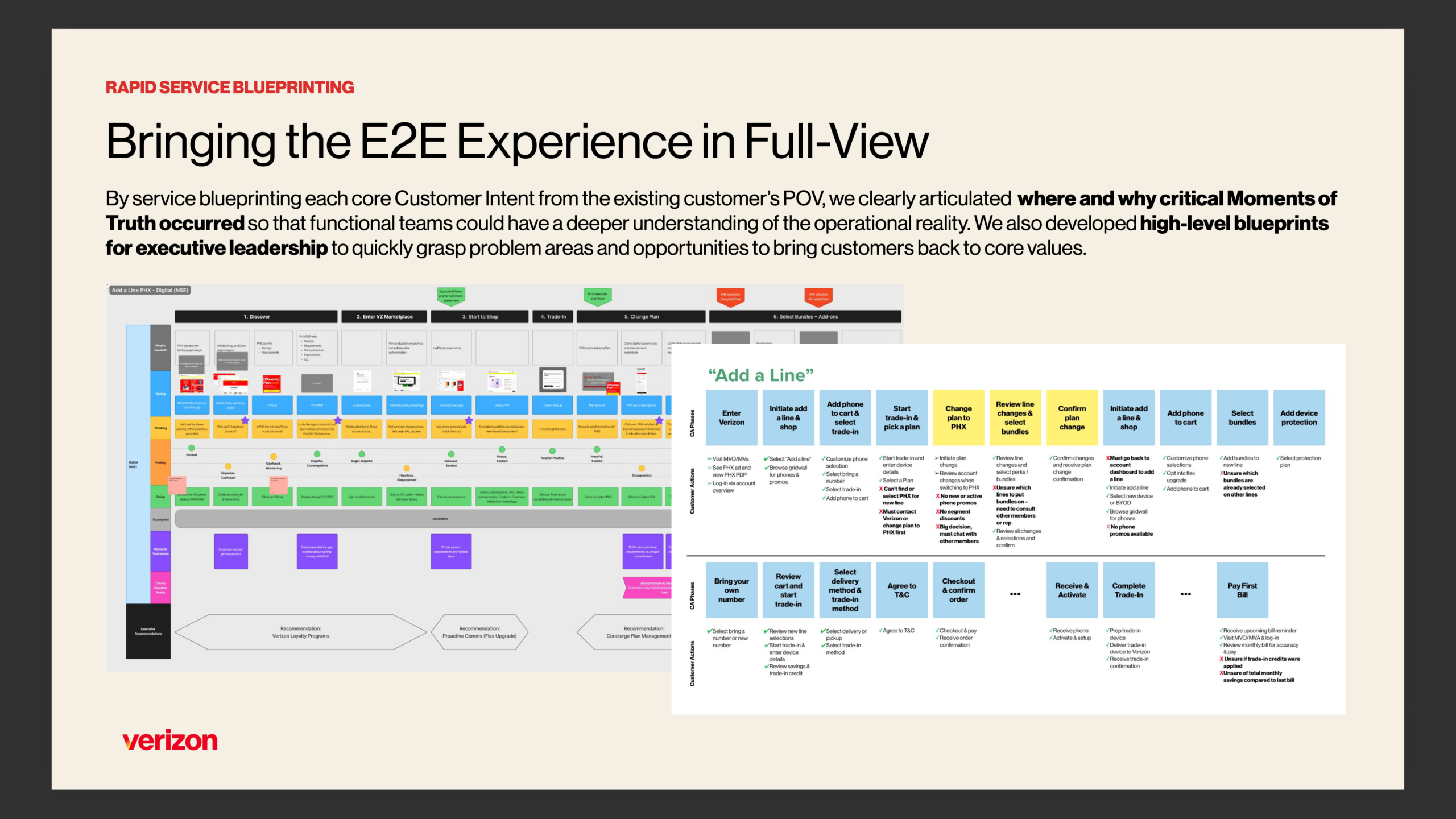
- An end-to-end omnichannel service blueprint for the Get a New Phone intent
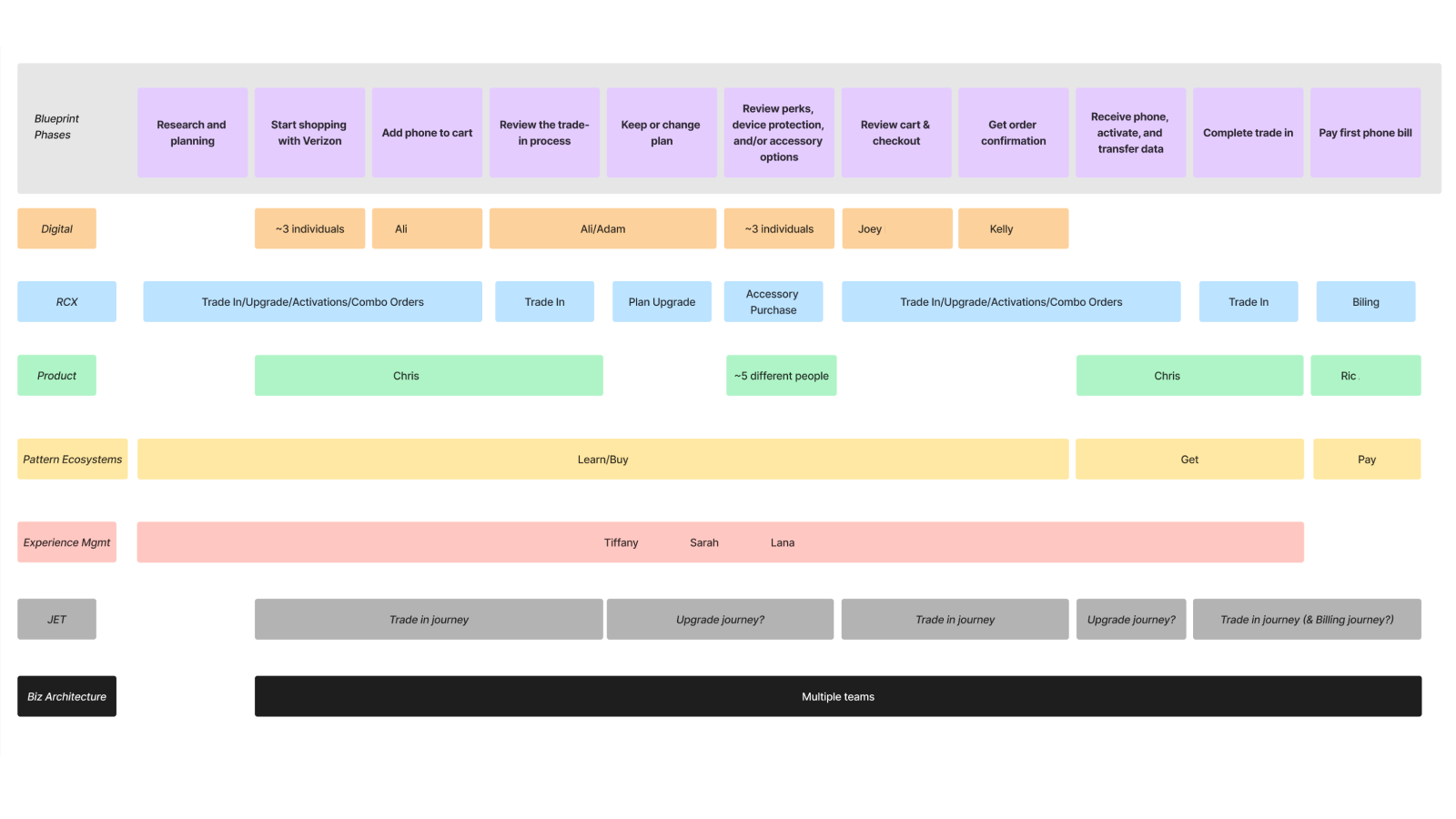
- Working relationships with the partner teams, who joined as subject matter experts
- A governance structure for how intents, journeys and blueprints get defined and owned
- A consolidated service design practice in place of parallel ones

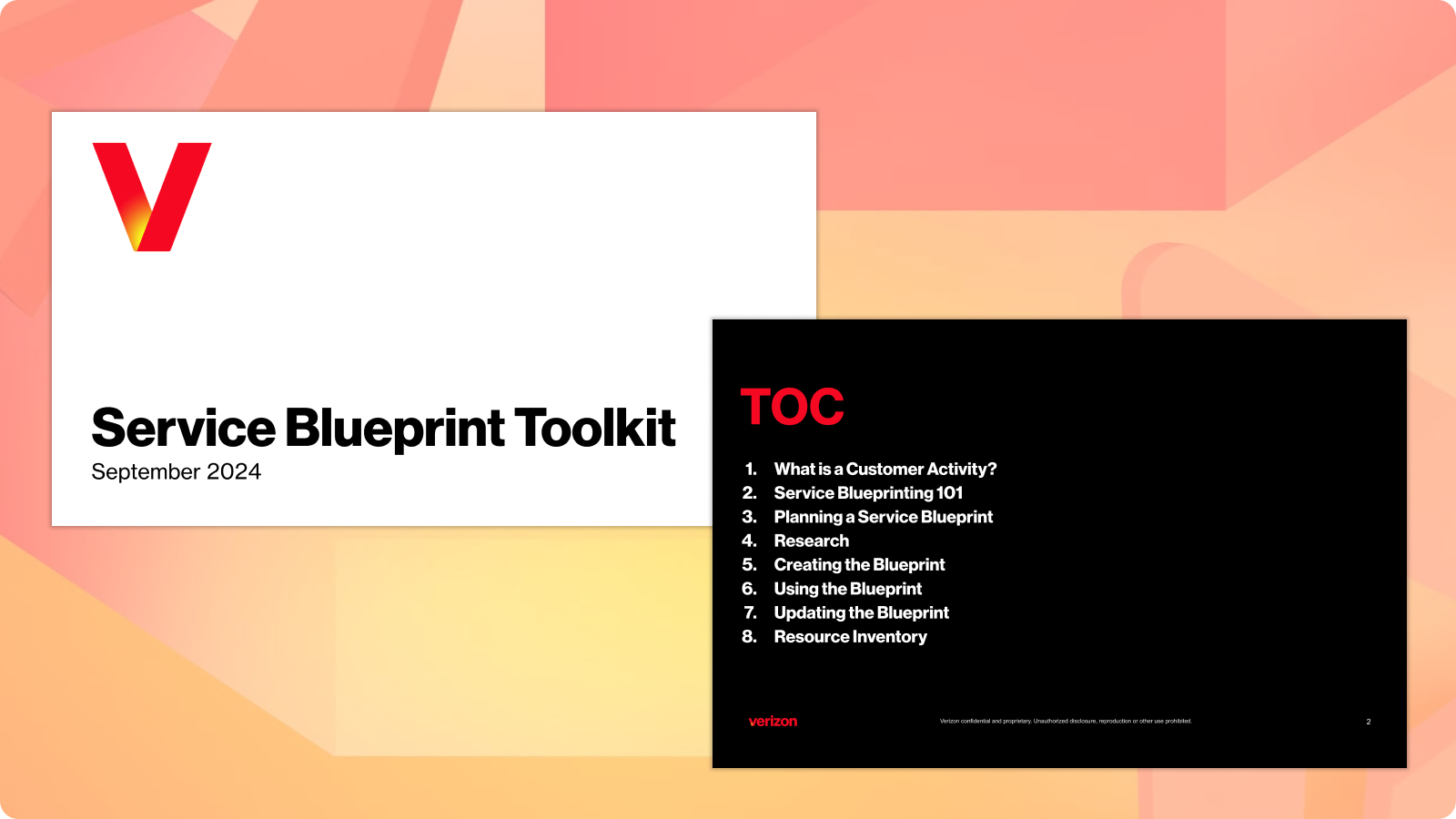
Scaling it: from one pilot to the whole design org
The pilot worked, and the mandate kept growing. I scaled the framework in three stages, each one building on the last:
- Pilot to partnership. Get a New Phone reconciled our framework with the legacy teams' and set up shared governance.
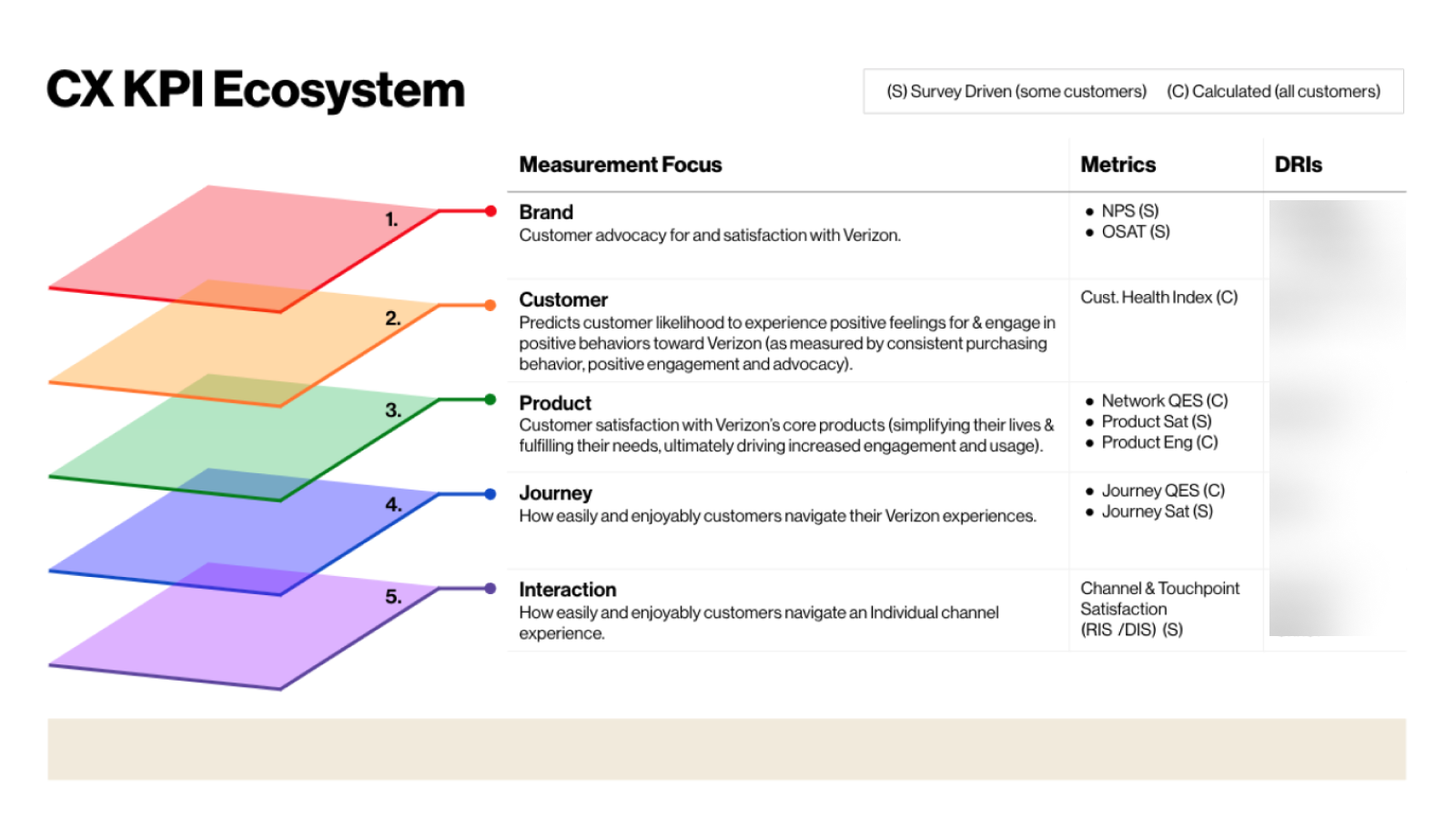
- Partnership to measurement. The intents became the backbone of a new UX metrics ecosystem, tying design work to what product teams track.
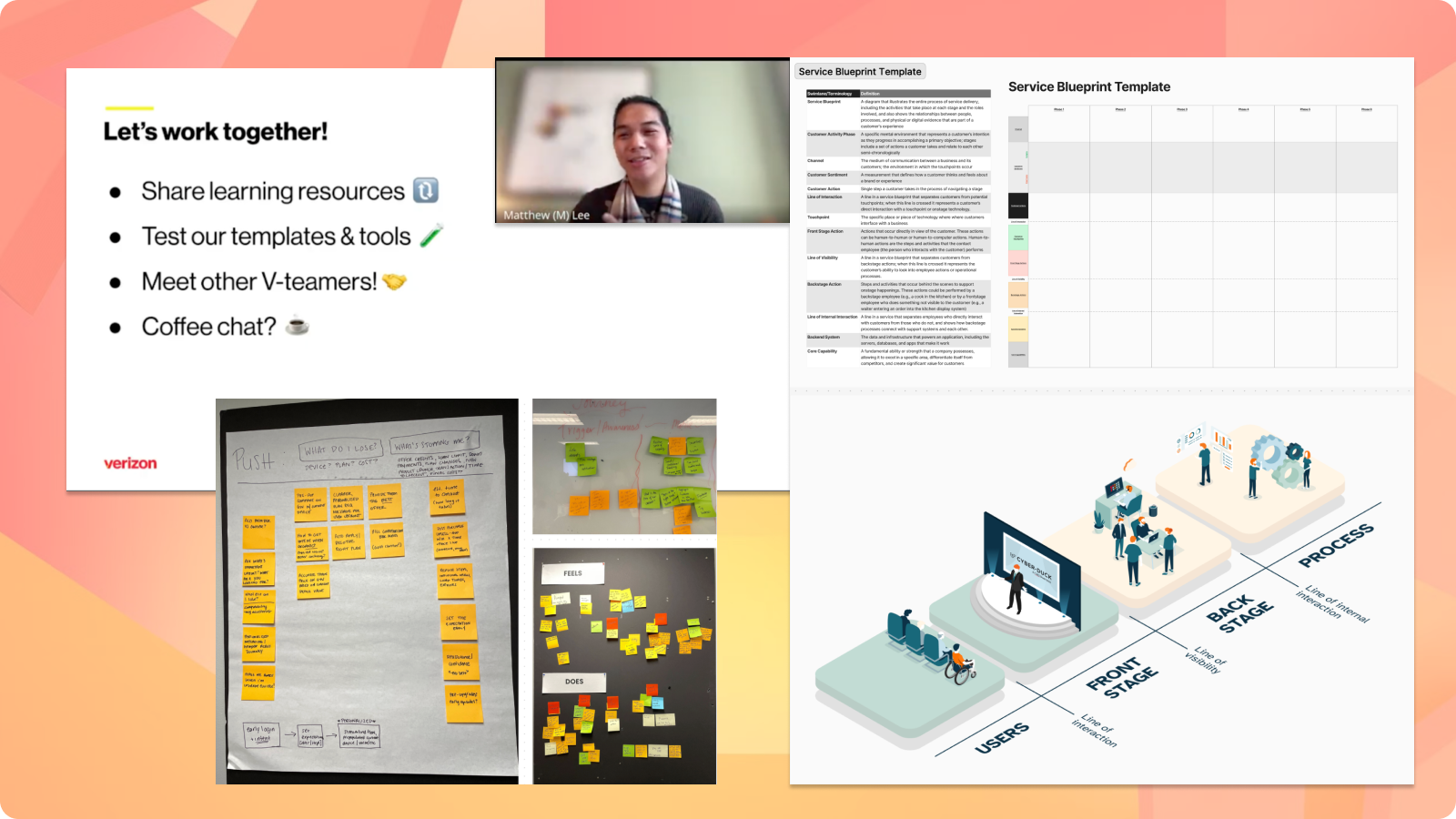
- Measurement to practice. I built a service blueprinting community of practice, grew it to 75+ practitioners, and trained designers to blueprint on their own.
Along the way, I delivered 6 core blueprints and ran ad hoc consultations so teams could apply my blueprints directly to their project work instead of starting from scratch. By the end, 15 teams had adopted the framework.

Challenges & how I overcame them
1. The new team vs. the legacy teams
The tension: We were the new team in the org. Legacy partners had decades of discoveries and established ways of working, and they had their own frameworks. They pushed back on adopting ours because it competed with theirs.
What I did: I stopped treating it as a contest. I brought partner teams into the Get a New Phone pilot as subject matter experts, credited their past work openly, and built the framework on top of their discoveries instead of replacing them. Together we set up a shared governance structure and consolidated our service design practices into one.
The result: Resistance turned into partnership. The framework became something legacy teams helped build, not something imposed on them, and it gave everyone a newer, more efficient way of working.
2. Leadership didn't know what they wanted
The tension: Priorities kept changing. The pilot started as a way to reconcile differences with partners, became the foundation for a UX metrics ecosystem, then became a mandate to scale a community of practice
What I did: I treated each shift as the next stage of the same system, not a restart. Because the intents framework was the common foundation, every new priority could build on what we had already delivered rather than throwing it away.
The result: Instead of being whipsawed by ambiguity, we shaped it. Each pivot expanded the framework's reach, and it ended up helping digital design teams work more efficiently and dissolving silos between them.
Big picture impact
One framework now connects every design team to product and research, and downstream teams reach a roadmap 40% faster.
40% faster research-to-roadmap
Time saved by downstream teams who use my blueprints instead of running their own research and process mapping
75% improvement in delivery & documentation
Blueprint and journey mapping delivery, plus research and process mapping documentation
15 teams adopted
Teams working from the Customer Intents Framework
75+ practitioners
Members of the service blueprinting community of practice
6 core blueprints
Built and delivered by me
Beyond the numbers
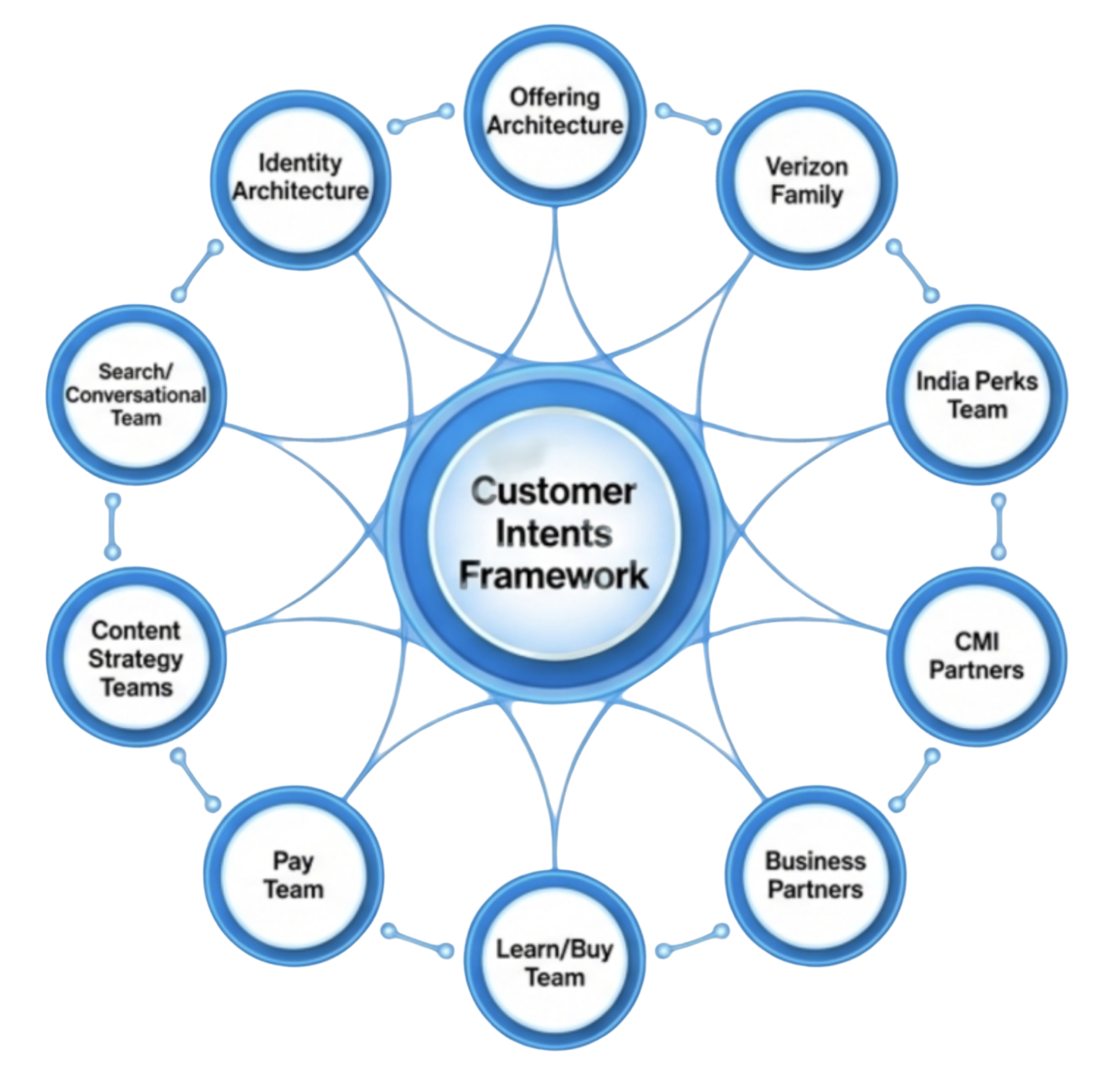
"By using customer intents as a shared language, it was so much easier to rally stakeholders and business partners around a common goal"
- One language. All design teams united under a central framework with shared vocabulary.
- Real partnerships. Close working relationships with product managers, product owners and the research team.
- A better operating model. A more efficient product operating model built around customer intents.
Customer Intents Framework In Action




Reflection
The biggest lesson: a framework isn't adopted because it's right. It's adopted because people helped build it.
What I'd do differently: plan for framework scaling at the launch to align with cross-functional priorities, and collaborate earlier with business and strategy partners to secure proactive buy-in.
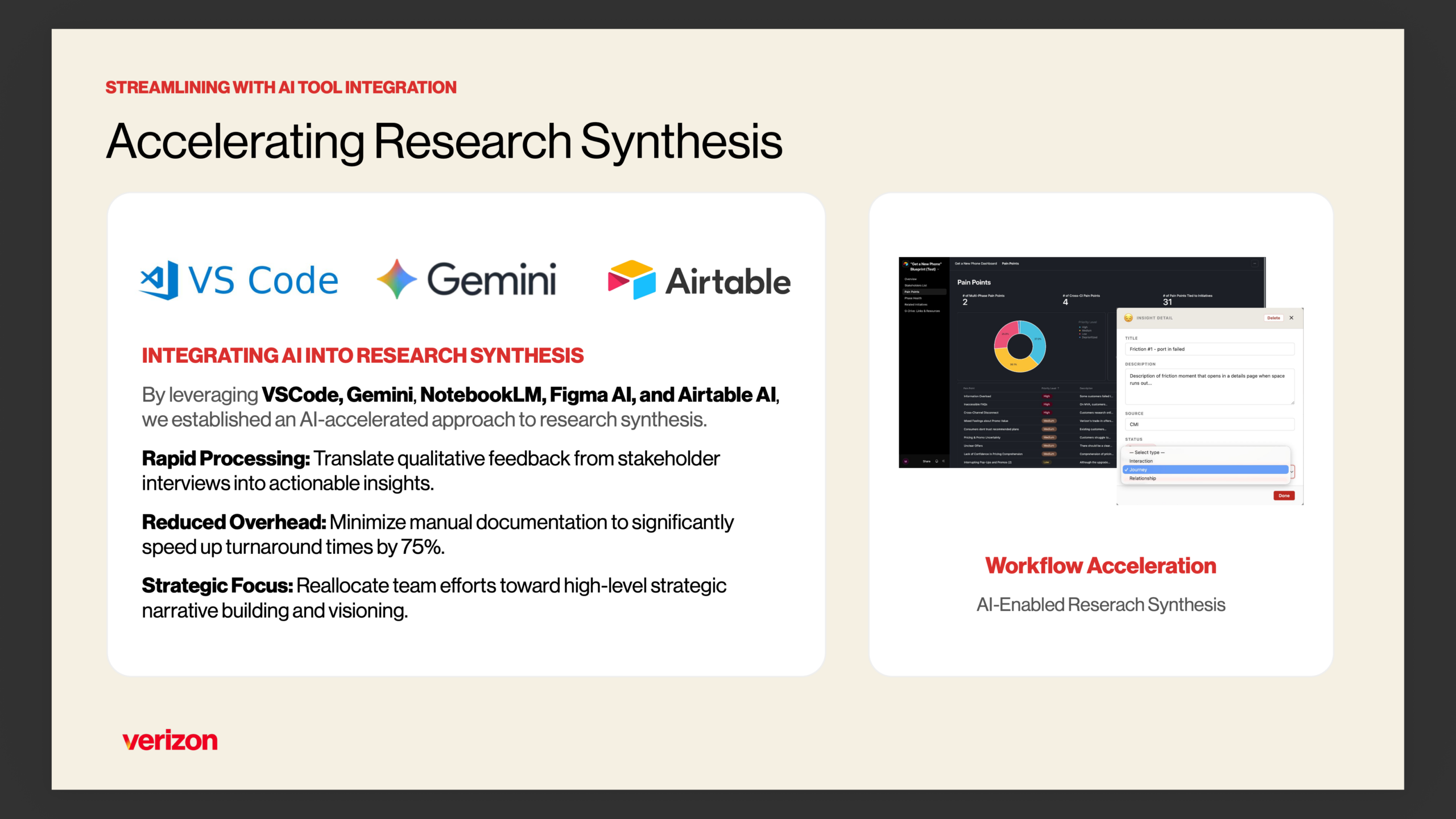
What I built next: an AI-powered ecosystem that connects VS Code, Figma, NotebookLM, and Airtable to streamline blueprinting and ensure data is always accurate and up to date.
The same approach works anywhere legacy systems and new ideas collide, whether that's a care journey in healthcare or a public service spread across agencies.